o
Examine the
reception of A Doll’s House at that time?
· was received both positively and negatively by
many critics at the time, due to its nonconformity to (Norwegian) upper-middle
class standards and gender roles
· After its initial premiere in Copenhagen, 1879, the play gave rise to much debate and controversy to the extent that people were requested not to discuss the play during social gatherings.
· FOR: argued that Nora’s “door-slamming exit” shed light on women’s roles in the 19th century and how socially trivialized women were in society; the play champions the humanity of people like Nora, as Ibsen opted for the play to communicate a person’s individual ideals rather than feminist ones {Ibsen noted that people were “being herded like sheep” by societal standards}; George Bernard Shaw praised Ibsen for challenging these societal standards
· The Melbourne premiere (1891): was set to show for six nights and was well-received; introduced an unfamiliar concept to the audience (Argus); was evident by the play’s positive reception that people became more aware and accepting of Ibsen’s ideals (was originally only set for three nights as another play was advertised to be performed, but was cancelled in favor of A Doll’s House); as the tour repertoire reached Sydney, initial shock had disappeared, reviews were mostly positive (trend: as the tour progressed, negative reception decreased)
· AGAINST: argued that Nora’s irresponsible decision to leave her family for selfish reasons led to the concern that the play was communicating a rather immoral idea to its audience, making them believe that their “duty to oneself” was far more important than their “duties to the family” --- this is in addition to the fact that Nora’s behavior at the end of the play was simply shocking, because this behavior was not expected of women in the 19th century
· Such a controversial ending compelled Ibsen to rewrite the ending of the play when the German actress playing Nora refused to play her part, as she was affronted by Nora’s decision to leave her family behind.
· Ibsen proclaimed at a banquet for the Norwegian’s Women’s Rights League that he “must disclaim the honor of having consciously worked for the women’s rights movement…True enough, it is desirable to solve the woman problem, along with all the others; but that has not been the whole purpose. My task has been the description of humanity.”
· After its initial premiere in Copenhagen, 1879, the play gave rise to much debate and controversy to the extent that people were requested not to discuss the play during social gatherings.
· FOR: argued that Nora’s “door-slamming exit” shed light on women’s roles in the 19th century and how socially trivialized women were in society; the play champions the humanity of people like Nora, as Ibsen opted for the play to communicate a person’s individual ideals rather than feminist ones {Ibsen noted that people were “being herded like sheep” by societal standards}; George Bernard Shaw praised Ibsen for challenging these societal standards
· The Melbourne premiere (1891): was set to show for six nights and was well-received; introduced an unfamiliar concept to the audience (Argus); was evident by the play’s positive reception that people became more aware and accepting of Ibsen’s ideals (was originally only set for three nights as another play was advertised to be performed, but was cancelled in favor of A Doll’s House); as the tour repertoire reached Sydney, initial shock had disappeared, reviews were mostly positive (trend: as the tour progressed, negative reception decreased)
· AGAINST: argued that Nora’s irresponsible decision to leave her family for selfish reasons led to the concern that the play was communicating a rather immoral idea to its audience, making them believe that their “duty to oneself” was far more important than their “duties to the family” --- this is in addition to the fact that Nora’s behavior at the end of the play was simply shocking, because this behavior was not expected of women in the 19th century
· Such a controversial ending compelled Ibsen to rewrite the ending of the play when the German actress playing Nora refused to play her part, as she was affronted by Nora’s decision to leave her family behind.
· Ibsen proclaimed at a banquet for the Norwegian’s Women’s Rights League that he “must disclaim the honor of having consciously worked for the women’s rights movement…True enough, it is desirable to solve the woman problem, along with all the others; but that has not been the whole purpose. My task has been the description of humanity.”
o
Examine other
productions of the play: 1880 German production- Why did Ibsen describe it as a
“barbaric outrage”? 1984 New York production removed reference to Nora’s
stockings. Other productions?
· · The German adaptation of the play was considered by Ibsen a “barbaric violence”, greatly expressing his dissatisfaction with the adaption in his letter to the manager of a theater in Germany.
· · The German adaptation of the play was considered by Ibsen a “barbaric violence”, greatly expressing his dissatisfaction with the adaption in his letter to the manager of a theater in Germany.
·
Ibsen was driven to
write an alternate ending when actress Hedwig Niemann-Raabe refused to proceed
with the final scene, because she exclaims that she would never leave her own
children as Nora did; after a multitude of complaints about the “distortion of
the play”, Niemann-Raabe eventually reverted to the original script.
·
Ibsen thought it
better than he write the alternate ending rather than have someone else do it.
·
“barbaric
outrage/violence” because the alternate ending eludes from Ibsen’s intended
message of the importance of self-realization to the individual, by having Nora
stay with Torvald after her husband forces her to see the children --- this not
only forces Nora to acknowledge her crime and guilt, but also shows the strong
influence of upper middle class and patriarchal male social standards,
rendering the inevitably powerless female compliant to a woman’s expected role,
denying Nora her choice of individual freedom
·
Other productions:
1.
The original script was forbidden to be
performed in London, a revised adaptation by the name of “Breaking a Butterfly”
was premiered at the Princess Theatre in London (adaptation by Henry Arthur
Jones and Henry Herman, 1884)
2.
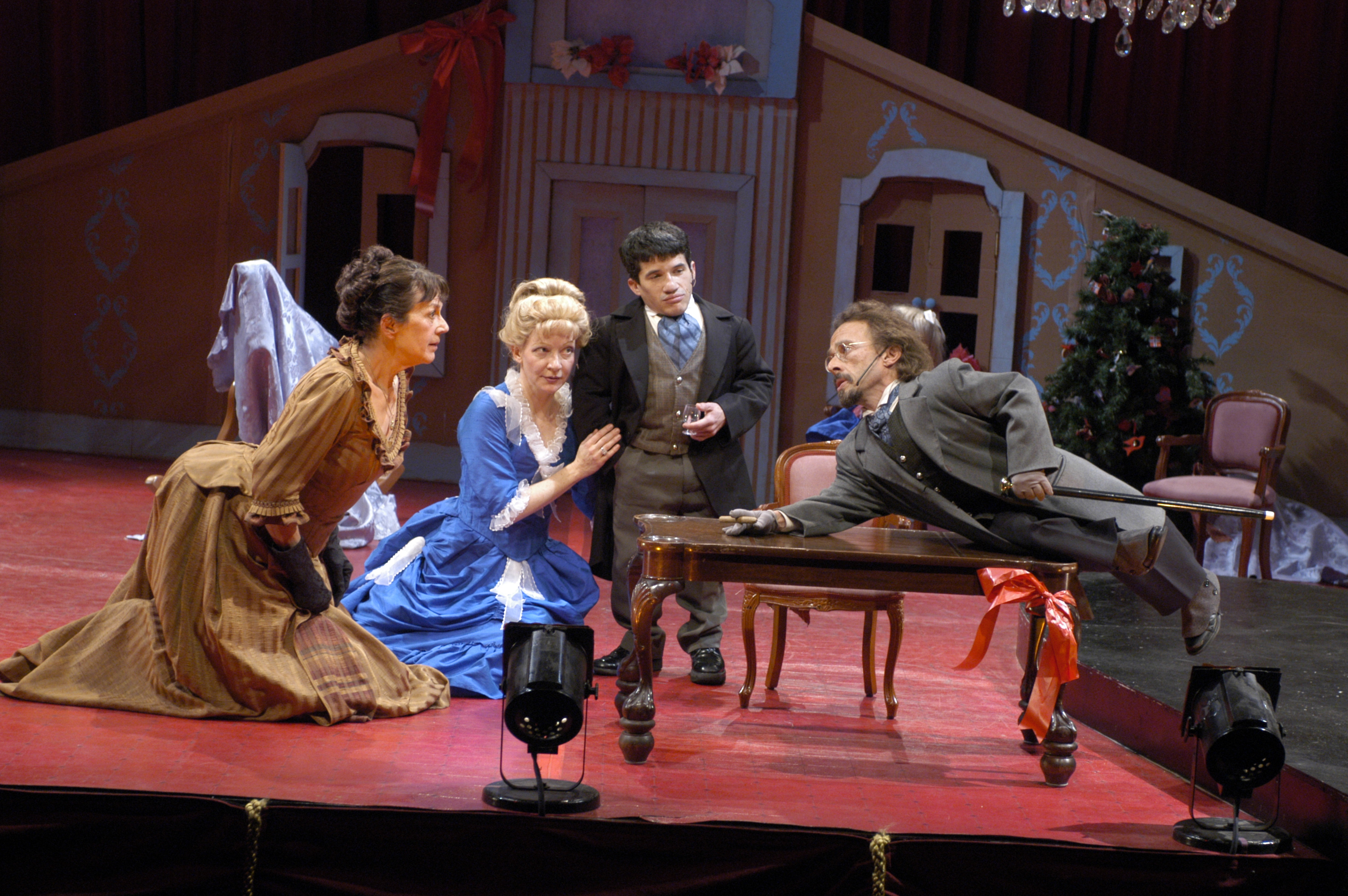
A modern 2007 version of the play premiered at
Edinburgh, with Lee Breuer
casting less than 4-feet-tall dwarves as the males; involved the risk of
including nudity and sex scenes to capture the modern audience
3.
Several versions were premiered in Chinese
theaters, with Nora as a western woman marrying into a Chinese family (2006),
and other versions portraying the Helmers as a typical Chinese family (2014).
® Many
Chinese women were motivated by A Doll’s
House to the extent that leaving their homes to avoid arranged marriages
seemed a plausible idea. On December 26, 1923, at the Peking Women’s Normal
College, Lu Xun talked about the importance of acquiring financial stability
among women (“What Happens After Nora
Leaves Home?”).
 |
[For Karim] What
to put on the slides for my part:
1st slide: How was A
Doll’s House received in the late 1800’s?
2nd slide: “Finally an event at The Royal Theatre, and an event of the first class! This play touches the lives of thousands of families; oh yes there are thousands of such doll-homes, where the husband treats his wife as a child he amuses himself with, and so that is what the wives become. . . Who, after seeing this play, has the courage to speak scornfully about run-away wives? Is there anyone who does not feel that it is this young and delightful young woman’s duty, her inescapable duty, to leave this gentleman? This husband, who slowly sacrifices her on the altar of his egotism, and who fails to understand her value as a human being?”
2nd slide: “Finally an event at The Royal Theatre, and an event of the first class! This play touches the lives of thousands of families; oh yes there are thousands of such doll-homes, where the husband treats his wife as a child he amuses himself with, and so that is what the wives become. . . Who, after seeing this play, has the courage to speak scornfully about run-away wives? Is there anyone who does not feel that it is this young and delightful young woman’s duty, her inescapable duty, to leave this gentleman? This husband, who slowly sacrifices her on the altar of his egotism, and who fails to understand her value as a human being?”
-
a
review written for Social Demokraten in 1879
3rd slide: “When the woman first
has risen, she will never let herself be stopped again. Like Nora, she will let
the duties that her doll-life gave birth to fall dead to the ground, because
the work with her own, neglected self will absorb and annul everything else.”
-
Amalie Skram, a Norwegian journalist writing in the
1880’s
4th slide: “I thank you for
the toast, but must disclaim the honor of having consciously worked for the
women’s rights movement…True enough, it is desirable to solve the woman
problem, along with all the others; but that has not been the whole purpose. My
task has been the description of humanity.”
- Henrik Ibsen, at a banquet for the Norwegian’s Women’s Rights League
- Henrik Ibsen, at a banquet for the Norwegian’s Women’s Rights League
5th slide: Why was the
German adaptation of the play a “barbaric outrage” to Ibsen?
6th slide:
6th slide:
NORA.
… Where we could make a real marriage out of our lives together. Goodbye.
[Begins to go.]
HELMER.
Go then! [Seizes her arm.] But first you shall see your children for the last
time!
NORA.
Let me go! I will not see them! I cannot!
HELMER
[draws her over to the door, left]. You shall see them. [Opens the door and
says softly.] Look, there they are asleep, peaceful and carefree. Tomorrow,
when they wake up and call for their mother, they will be – motherless.
NORA
[trembling]. Motherless…!
HELMER.
As you once were.
NORA.
Motherless! [Struggles with herself, lets her travelling bag fall, and says.]
Oh, this is a sin against myself, but I cannot leave them. [Half sinks down by
the door.]
HELMER
[joyfully, but softly]. Nora!
[The
curtain falls.]
7th slide:
Other productions:
Other productions:
o
1884 revised adaptation by the name of “Breaking a Butterfly” by Henry Arthur
Jones and Henry Herman, premiered at the Princess Theatre in London
o
A modern 2007 version of the play, titled “Mabou Mines Dollhouse”, premiered at
Edinburgh, with Lee Breuer
casting less than 4-feet-tall dwarves as the males [include this photo: http://www.maboumines.org/wp-content/uploads/2009/06/DH083.jpg]
o
Chinese adaptations with several
variations

No comments:
Post a Comment